
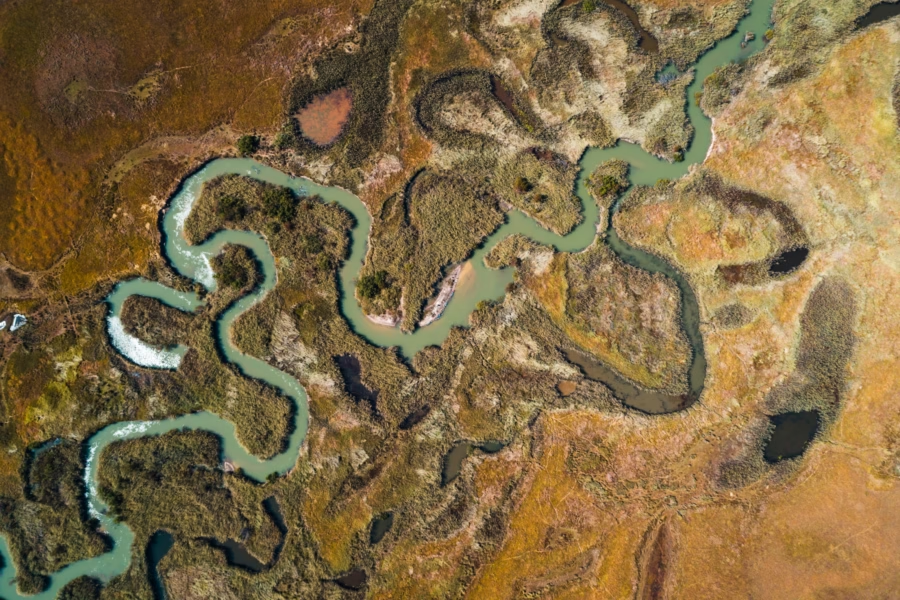


A wetland can look peaceful while an invisible chemical process is unfolding at its surface. In waterlogged soils, microorganisms break down organic material under low-oxygen conditions and can produce methane, a potent greenhouse gas. Some of that methane eventually reaches the atmosphere.
In the Okavango Delta, Dr Mangaliso Gondwe and Wellington Masamba measured how those emissions varied across channels, floodplains, lagoons, permanent swamps and seasonal swamps. Their work offers a useful lesson in climate science: a landscape can help sustain extraordinary biodiversity while also participating in the natural greenhouse-gas cycle.
The short version
Wetlands naturally emit methane. The important scientific questions are how much, from where, when, and what controls the variation. Measuring those patterns gives researchers a baseline for understanding future change.
Why wetlands produce methane
When soils are saturated with water, oxygen moves through them less easily. Microbial communities then use different chemical pathways to decompose organic matter, and methane can be one of the products. The gas may dissolve in water, travel through plants, form bubbles or diffuse into the atmosphere.
That does not make wetlands 'bad for the climate'. Wetlands perform many ecological functions, including storing water, supporting biodiversity and cycling nutrients. Climate science is not a moral scorecard; it is an attempt to measure interacting processes accurately.
What the Okavango measurements found
The 2014 study measured diffusive methane emissions using static chambers in different Delta habitats. Emissions varied widely. The researchers reported higher average fluxes in river channels than in floodplains and lagoons, and higher emissions in permanent swamps than seasonal ones.
Season also mattered. The authors found much higher emissions during warmer, rainy periods and much lower emissions during the cooler winter season, pointing to temperature as an important control. This variation is crucial: using one measurement to represent the entire Delta would miss how strongly emissions change across space and time.
Think of it like taking a pulse
A single methane reading is like checking a person's pulse once. It tells you something, but not whether that number is typical, seasonal or changing. Researchers need measurements in different habitats and seasons before they can understand the system's normal range.
That baseline becomes especially valuable when climate conditions shift. If temperature, flood timing or inundated area changes, scientists can compare new observations with earlier measurements and ask whether the Delta's methane dynamics are also changing.
The science has continued to develop
ORI continues to study wetland fluxes, water, climate and biogeochemistry. Later research involving Okavango scientists has examined additional controls on methane emissions, reinforcing the idea that wetland greenhouse-gas behaviour depends on ecological timing and hydrological conditions.
The broader point is that the Delta is not a static carbon source with one permanent number attached to it. It is a dynamic wetland whose emissions respond to habitat, flooding, temperature, vegetation and biological activity.
Why Botswana should care
Botswana is custodian of one of the world's best-known tropical wetlands. Having local capacity to measure greenhouse gases means the country does not have to understand its ecosystems only through global averages or models built elsewhere.
Local measurements improve global science, but they also strengthen Botswana's ability to interpret climate risks using evidence generated in the landscape itself.
What happens next
Methane is invisible, but measuring it reveals how much activity is hidden beneath apparently still water. The Okavango study shows why climate research depends on patient measurement: different habitats behave differently, seasons matter, and natural systems rarely fit into a single number.
As the climate changes, the value of that baseline grows. To understand what is changing tomorrow, scientists first need to know how the Delta behaves today.
Sources & further reading
- Gondwe & Masamba — Spatial and temporal dynamics of diffusive methane emissionsPrimary research paper, Wetlands Ecology and Management.
- ORI — Dr Mangaliso John GondweResearcher profile and expertise.
- ORI — Water Resources ManagementCurrent/previous methane and water research context.