

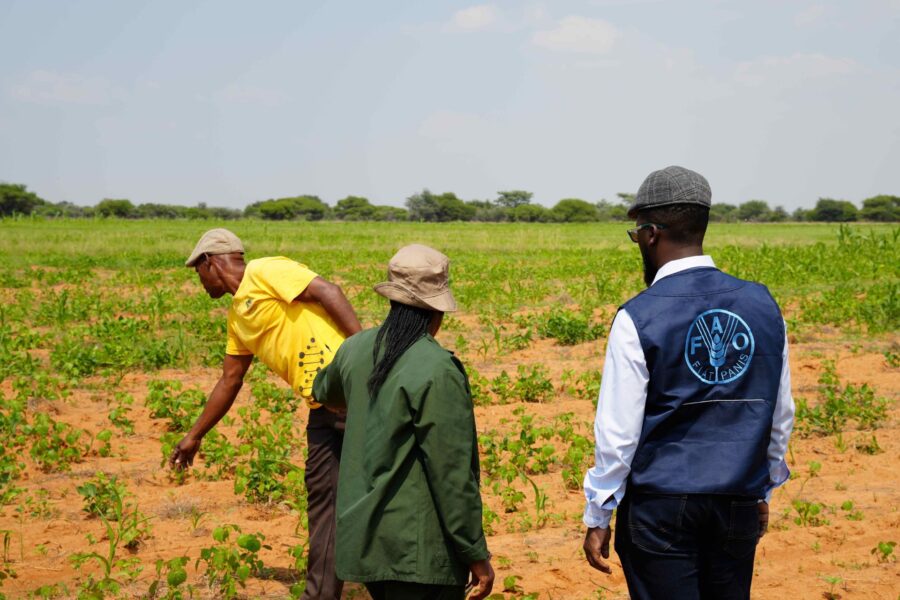
Before a forecast appears on a phone, people have already been watching the sky, plants, insects, birds, wind and seasonal rhythms. For farming communities, these observations are not simply folklore; they can form part of a practical system for deciding when to prepare fields, plant crops or expect changing weather.
Research led by Professor Oluwatoyin Dare Kolawole in the Okavango Delta asked whether this local weather knowledge and scientific forecasting have to compete or whether they can inform one another.
The short version
Traditional forecasting and scientific forecasting observe the same world at different scales. The useful question is not which one should defeat the other, but how reliable local observations and scientific data can be combined to support better decisions.
How farmers read a season
Ethno-meteorology refers to local systems of interpreting and anticipating weather. In many farming communities, knowledge develops through repeated observation: the timing of flowering, insect activity, migratory birds, winds, cloud behaviour and other environmental cues.
The 2014 Okavango study interviewed 592 household heads across eight rural communities as well as 19 scientists. It also used focus groups, key-informant interviews, workshops, climate-service data and satellite rainfall products. That combination is important because the researchers were not simply documenting beliefs; they were comparing different ways of producing and using weather knowledge.
Different tools answer different questions
A farmer observing conditions around a village may notice highly local signs that a national forecast cannot describe in detail. A meteorological service, meanwhile, has access to instruments, historical datasets, satellite observations and models that no individual farmer can reproduce.
A familiar analogy is navigation. Someone who has driven the same village road for twenty years may know exactly where water collects after heavy rain. A national road map cannot replace that experience. But local experience also cannot show the condition of every road hundreds of kilometres away. The two sources become more useful when they are connected.
What the research found
The study found relationships between farmers’ perceptions and factors including age, education, farming experience, sources of weather information and knowledge of forecasting. Farmers and scientists did not always perceive local and scientific knowledge in the same way.
The researchers nevertheless highlighted farmers’ ability to anticipate seasonal conditions through long-standing weather knowledge, allowing changes in farming calendars and crop choices. The article argued for interaction between farmers and scientists rather than treating knowledge systems as isolated camps.
Climate change makes the conversation harder—and more important
Local knowledge is built from experience, but climate change can alter the patterns on which that experience depends. A sign that was reliable for decades may become less dependable if temperatures, rainfall timing or ecological behaviour shift.
Scientific forecasts also contain uncertainty, especially at the local scale. Combining observations does not eliminate uncertainty; it can instead help communities understand what is known, what is changing and where confidence is limited.
Design information around decisions
The most useful forecast is not necessarily the one with the most technical detail. It is the one that helps answer a decision: Should planting begin? Is a dry spell likely? Should a farmer choose a different crop? Is river flooding expected to affect access?
That suggests an important design principle for climate services in Botswana: start with the decision people need to make, then work backwards to the information that can support it.
What happens next
Traditional weather knowledge and modern forecasting do not need to occupy opposite sides of a debate. Both are attempts to read patterns in a complicated environment, using different tools and scales.
The strongest approach is likely to be collaborative: preserve and test locally grounded knowledge, improve access to scientific forecasts, and create spaces where farmers and scientists can compare what each is seeing. In a more variable climate, better conversation may be as important as better prediction.
Sources & further reading
- Kolawole et al. — Ethno-meteorology and scientific weather forecastingPrimary open-access research paper in Climate Risk Management.
- ORI — Professor Oluwatoyin Dare KolawoleResearcher profile and research areas.